Jasola Apollo or Shaheen Bagh Metro: Which Station Fits Your Hotel Route?
Jasola Apollo is on the Violet Line, while Jasola Vihar Shaheen Bagh is on the Magenta Line. Neither station is automatically the better hotel stop: start with the line you will use and the exact destination you need to reach, then compare the complete final leg from each station.
That distinction matters because the shared word “Jasola” can make the stations look interchangeable in a search result. They are different points on different lines, so a useful comparison begins with your journey rather than the station name.
Compare the stations by line and onward side
Use the “side to investigate” column as a prompt for route checking, not as a promise that a station is closest. A destination described as being in Jasola may still have an entrance or practical approach that changes the final leg.
| Station | DMRC line | Useful direction or side to investigate | Verify before choosing |
|---|---|---|---|
| Jasola Apollo | Violet Line | The Apollo or district-centre side, or an onward journey already aligned with the Violet Line | The exact destination entrance, current metro route and final leg |
| Jasola Vihar Shaheen Bagh | Magenta Line | The Jasola Vihar or Shaheen Bagh side, or an onward journey already aligned with the Magenta Line | The exact destination entrance, current metro route and final leg |
The line assignment is the firm starting fact. Everything after that is trip-specific. If your arrival route requires an interchange, compare that interchange together with the last leg rather than treating either element in isolation. A direct-looking metro journey can still be inconvenient for a particular address, while a route with an interchange may work better for a different destination.
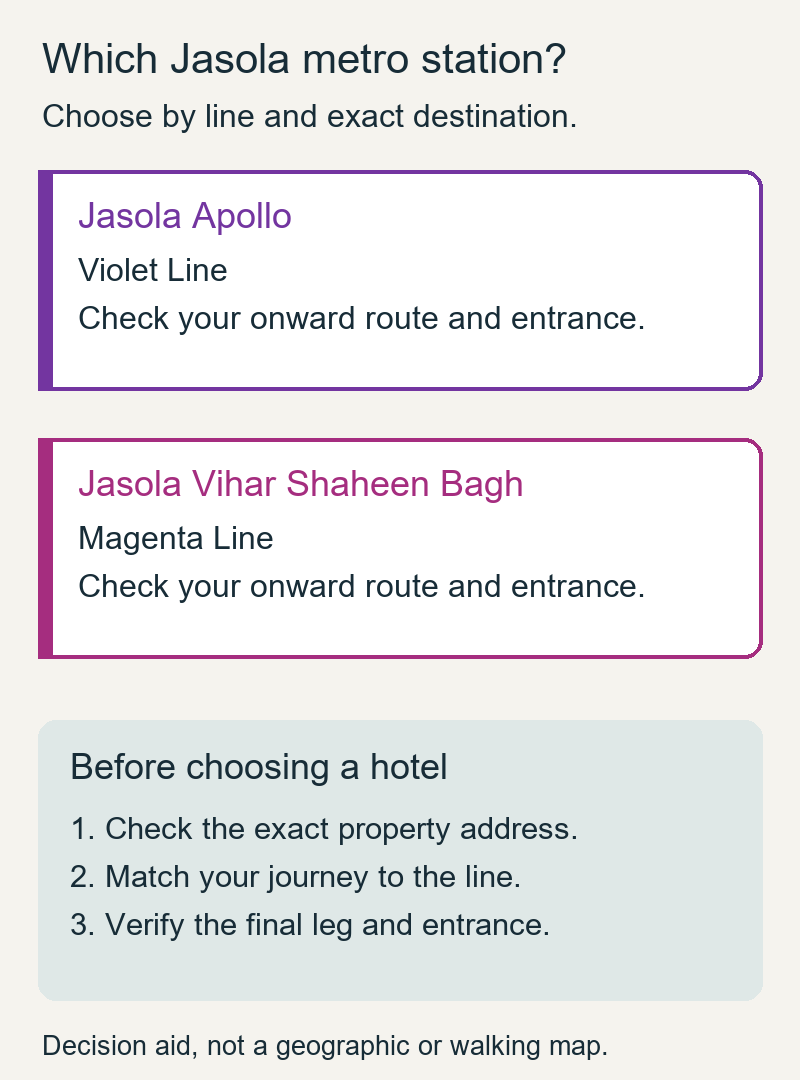
Use a four-check decision process
-
Pin the exact destination or entrance. Search with the full address, not just “Jasola.” Large sites, road layouts and similarly named places can produce different approaches. If the destination provides a specific entrance or meeting point, use that detail in the comparison.
-
Identify your arrival line and any interchange. Check where your Delhi Metro journey begins and which line carries the largest part of it. Compare the routes to the Violet and Magenta lines without assuming that fewer stations or a shorter-looking diagram always means a faster trip.
-
Compare the final leg from both candidates. Use current route information for the travel date and look at the whole connection from station exit to destination. Do not rely on an old walking estimate, an unverified gate number or a hotel listing that mentions only one station. Record practical needs such as luggage or step-free access separately, because they may change which route is workable.
-
Recheck before leaving. Network information, service conditions and the practical final approach can change after you plan. Confirm the chosen route shortly before travel and keep the other station as a comparison, especially if the journey depends on an interchange.
Make the comparison with the same inputs on both sides. A useful note can have one row for each station and five fields: your starting station or line, the interchange you would make, the exact destination entrance, the planned final-leg mode, and any luggage or accessibility constraint. Add the time when you checked each route. This prevents a common comparison error: using a current, entrance-specific route for one station but an older neighbourhood-level estimate for the other.
If the two options still look similar, identify the difference that would actually change your trip. That may be an extra interchange, an unsuitable final approach with luggage, or uncertainty about the destination entrance. Verify that deciding factor with current information instead of choosing from the station names. If the deciding detail cannot be confirmed, keep both routes provisional and check again closer to departure; do not convert an uncertain estimate into a permanent recommendation.
This process produces a decision for one actual trip. It does not create a permanent ranking of the two stations, and another traveller with a different origin or destination entrance may reasonably choose the other one.
Apply the method to JKM Palace at Plot 81
For JKM Palace, use the complete confirmed address: Plot 81, Jasola Vihar Main Road, New Delhi. The address identifies what to compare; by itself, it does not prove that either metro station is nearest, walkable or a fixed number of minutes away.
- Enter the full Plot 81 address when checking a route from Jasola Apollo.
- Run the same check from Jasola Vihar Shaheen Bagh with the same travel date and practical requirements.
- Compare the complete journeys, including the metro line, any interchange, the exact destination pin or entrance, and the final approach.
Choose only after those two checks use equivalent inputs. Comparing a full address from one station with a neighbourhood label from the other produces a misleading result. If the destination pin or entrance is unclear, resolve that uncertainty before treating a route estimate as decisive.
Once the location choice is settled, the separate Jasola Apollo Hospital hotel stay checklist can help with stay preparation. It serves a different purpose and is not evidence that either station is better for Plot 81.
Recheck these details on the travel day
| Check | What to confirm | When the choice should change |
|---|---|---|
| Metro network and service | Current line information and any service notice relevant to the planned journey | Recompare the routes if the intended line or interchange is affected |
| Destination pin or entrance | The exact arrival point for the full address | Recalculate the final leg if the pin or entrance differs from the one originally used |
| Final-leg route | Current practical route from each candidate station, including accessibility needs | Select the station that now gives the more workable complete journey |
The official Delhi Metro network map is the primary reference for the station names and their line assignments. Use current route information for the destination-specific final leg; the diagram above deliberately makes no claim about distance, scale, gates or travel time.